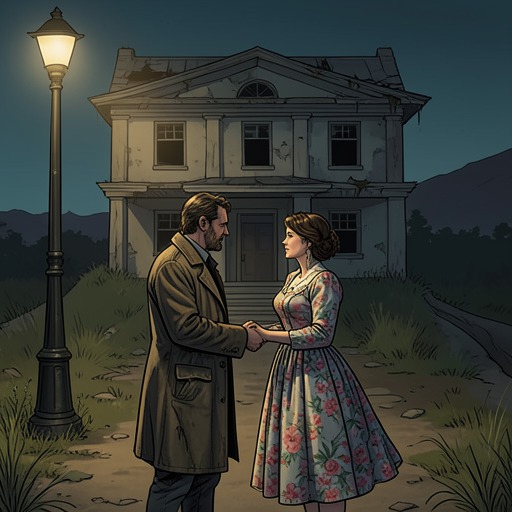
Ben Mears and Susan Norton’s sexual encounter
'Salem's Lot: A NovelBen Mears and Susan Norton’s sexual encounter marks the moment when their attraction becomes an acknowledged relationship. What begins as an ordinary evening choice—to avoid Spencer’s and go instead to the town park—develops into mutual physical intimacy and then into a more dangerous form of emotional confidence, because Susan couples her declaration of love with a warning that Ben is already under suspicion in Jerusalem’s Lot.
From Town Street to Private Space
Susan proposes the park rather than Spencer’s, and Ben answers her light concern about muggers by joking in an exaggerated Bronx accent. She replies that, in Jerusalem’s Lot, muggers must be indoors by seven according to a town ordinance, although it is already eight-oh-three. The exchange establishes the scene’s initial register: flirtation, local humor, and a shared ease in a town whose darkness has not yet fully invaded their immediate experience.
The walk also places their intimacy within the distinctive social atmosphere of Jerusalem’s Lot. The town is shaped by surveillance, gossip, and inherited memory. Its telephone wires seem to carry voices as well as messages, and the local community continually turns private behavior into public knowledge. Even the park, therefore, is not an entirely neutral refuge. Ben and Susan seek a space away from ordinary business, but they remain inside a town that remembers everything and interprets every attachment.
Conversation, Disclosure, and Attraction
In the park, Susan asks what Ben’s new book is about. He initially finds the question difficult to answer, yet he unexpectedly allows her closer than he had allowed Miranda. His earlier refusal to discuss works in progress had been protective; he treated an unfinished book as vulnerable and believed that excessive questioning could damage it. With Susan, however, conversation does not feel like interrogation. Her interest becomes evidence that he can trust her with something unfinished.
That disclosure changes the emotional balance between them. Ben is not merely entertaining Susan or responding to her beauty; he is permitting her access to a guarded part of his identity. The conversation then gives way to physical contact. Susan asks whether he can kiss her while he thinks, and Ben answers indirectly that a kiss might interfere with his thought processes before accepting the invitation. Their kiss becomes increasingly mutual as she meets his mouth firmly, closes her hands over his, and responds more fully to him.
The scene’s physical details make attraction an embodied experience before it is explained in abstract terms. Ben notices the shortness of Susan’s skirt, the sound of its cotton moving in the darkness, and the shifting pressure of their bodies. The narration presents desire as an intensification of perception: the park’s grass, the night, and the surrounding shadows remain present, but their significance is reorganized by the couple’s growing closeness.
The Sexual Encounter and Its Immediate Meaning
Susan then asks, “Make love to me? Do you want to?” Ben answers, “Yes,” and confirms that he wants her. When she specifies that it should happen on the grass, the decision becomes openly mutual rather than an action imposed by one partner. Their lovemaking is described elliptically as their bodies becoming shadows in the dark, preserving the privacy of the act while making its emotional importance unmistakable.
The encounter produces a clear value shift in the relationship. Before the park scene, Ben and Susan are attracted to one another but remain within the uncertainty of a new attachment. Afterward, their relationship has crossed into sexual and emotional commitment. The event also contrasts with the town’s broader atmosphere. Jerusalem’s Lot is increasingly defined by secrets, violence, and the slow return of buried evil; Ben and Susan’s intimacy briefly creates an alternative vocabulary of touch, consent, and mutual recognition.
That contrast is not entirely reassuring. The encounter occurs in a town whose past is saturated with the Marsten House scandal, whose residents preserve old horrors across generations, and whose current anomalies are already producing rumors of haunting, a dark coven, and unexplained disappearances. The couple’s private happiness therefore develops inside a landscape that the narrative has already marked as morally and supernaturally contaminated.
Love Followed by Warning
The scene’s most consequential turn comes after Susan leaves Ben’s arms. She asks him to do something important for her and tells him not to mention the strange matters they have discussed to anyone else in town. Her request transforms the encounter from a romantic interlude into a moment of shared danger. She understands that information in Jerusalem’s Lot does not remain private, and she recognizes that Ben’s curiosity has placed him within the town’s network of suspicion.
Susan specifically tells Ben to begin locking his room at Eva Miller’s boardinghouse and to think of himself as under suspicion. When he asks whether that includes her, she replies that he would be under suspicion if she did not love him. The statement is both a declaration and a boundary: love makes her willing to trust him, but it does not erase the threat surrounding them. Her warning also gives the relationship a protective function. Susan does not simply yield to intimacy; she uses the confidence created by intimacy to urge Ben toward caution.
Ben is left stunned after she hurries up the driveway. The emotional aftermath is therefore deliberately asymmetrical in appearance: the sexual encounter has brought them together, but Susan’s final words leave Ben with a new burden of knowledge. The scene joins desire to secrecy and affection to surveillance, anticipating the later point at which private relationships in Jerusalem’s Lot become inseparable from the struggle against supernatural violence.
Narrative and Thematic Significance
Ben Mears and Susan Norton’s sexual encounter is important not because it merely confirms physical attraction, but because it makes their relationship an active alliance. Ben shares access to his creative and personal life; Susan responds with bodily openness, verbal consent, love, and a warning about the town. Their connection is thus established through reciprocal acts rather than through romantic sentiment alone.
The event also places ordinary human intimacy against the town’s long historical memory. Jerusalem’s Lot was incorporated in 1765, but its identity reaches further back through stories of settlers, religious extremity, unexplained disappearances, and violence attached to the Marsten House. The narrative repeatedly shows that the town’s inhabitants know fragments of its past without knowing the whole truth. In that context, Susan’s warning carries the same structural importance as the couple’s lovemaking: both reveal that what appears private is already caught inside a larger system of hidden knowledge.
The encounter briefly creates a living counterforce to the town’s deathly stillness. Jerusalem’s Lot is later characterized as a place that sleeps like the dead, a community whose secrets are preserved through gossip and whose evil seems to have been waiting for its return. Against that background, Ben and Susan’s movement from joking conversation to trust, desire, and mutual protection becomes a fragile assertion of life. The scene does not promise a secure romantic resolution; instead, it establishes the love that will make the coming danger more intimate, more intelligible, and more costly.